The fabricated MS Pipes are not the ordinary pipes that you pick up at the shelf. These are standard Mild Steel pipes which have been made to be modified, shaped or assembled in a way that suits the non-standard requirements of a project. The very concept of fabrication consists of a set of operations which will turn a simple MS pipe into a tailor-made element. The manufacturing process may be divided into two major important steps: the production of the base pipe and the fabrication process.
The raw material for fabrication begins as a standard MS pipe, primarily manufactured through two methods:
Electric Resistance Welding (ERW): This is the most widespread technique. The mild steel strip coils are uncoiled and then rolled into a cylindrical form using rollers. The edges of the steel are clamped and electric current channelled through the edges creates sufficient heat as a result of resistance to bind the edges together without using a filler material.
Seamless Pipe Manufacturing: For applications requiring higher pressure tolerance, seamless pipes are used. This process involves heating a solid cylindrical steel billet and then piercing it with a mandrel to create a hollow shell. It is then elongated and rolled to achieve the desired diameter and wall thickness. Seamless pipes have no welded seam, making them uniformly strong around their circumference.
These base pipes are then cut to standard lengths and made available for further fabrication.
This is where standard pipes are customised. The fabrication process typically involves the following steps:
Cutting and Bevelling: All the standard-length pipes are cut using a tool such as a band saw, abrasive chop saw, or plasma cutter to the exact size needed before the project. In case of pipes that require joining by welding, the ends are commonly bevelled thus forming a V-groove. This will enable the penetration of the weld to become deeper and the joint to be stronger and more dependable.
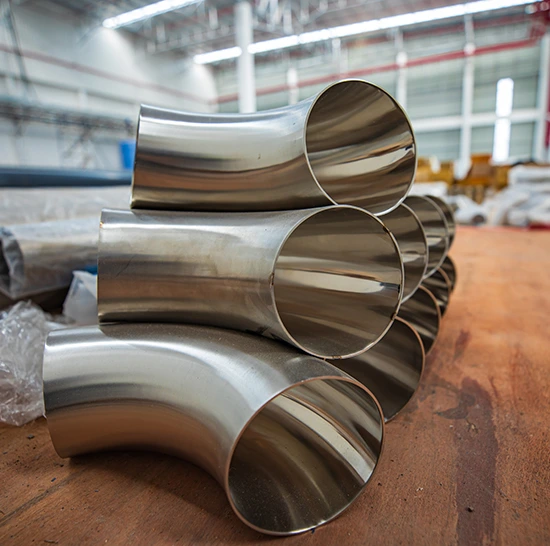
Bending and Forming: This is a significant part of fabrication, namely the formation of the pipe. It is done through specialised machinery including rotary draw benders, induction benders or roll benders. These machines are used to bend the pipe to some extent to bend to certain angles and radii without kinking or collapsing the pipe which is necessary in more complex structural frameworks and handrails.
Welding and Assembly: This is the fabrication itself. Different fragments and cuts are welded together to form a bigger structure with 2 types of welding techniques, MIG (Metal Inert Gas) or TIG (Tungsten Inert Gas) welding. Other parts such as flanges (to connect to the other pipes or equipment), brackets, nozzles or supports are also attached to the pipe during this stage.
Drilling and Machining: Openings are cut or tapped on the side walls of the pipes to allow the fitting of bolts, sensors, drainage valves or branch connections. High precision and repetitive drilling are some of the common jobs performed using CNC machines.
Customisability: This is their characteristic feature. They are industrially fabricable to virtually any shape, size or configuration and can fit to unique specifications of design not possible using standard pipes.
High Strength: Mild steel has good strength to weight ratio, and hence fabricated MS pipes are better when used in load bearing structures and stressful uses.
Weldability and Ductility: Mild steel is considered easy to weld, cut and form, which makes the fabrication process efficient, and can be designed in a complex way.
Cost-Effectiveness: Mild steel is among the least expensive metals and the made MS solutions are highly cheap regarding large-scale projects.
Durability: When properly protected with paint or galvanisation, fabricated MS pipes exhibit excellent resistance to wear, impact, and environmental degradation.
Versatility: Their properties can be tailored through fabrication and finishing to suit a wide range of environments, from indoor dry conditions to harsh outdoor settings.
The ability to customise MS pipes makes them indispensable across numerous industries:
Construction and Infrastructure: Used for structural frameworks, roof trusses, space frames, handrails, balustrades, gates, and scaffolding systems.
Industrial Piping Systems: Fabricated into complex networks for transporting water, air, gases, and other industrial fluids. This includes systems with custom bends, tees, reducers, and flanged assemblies.
Material Handling: It is used to build the conveyor system frames, roller supports and storage racks systems because of its strength and durability.
Agricultural Equipment: Comprising of the beams of machinery, irrigation system booms and greenhouse structures.
Automotive and Transportation: It can be used in making vehicle chassis, roll cages and other structural components of trailers and buses.
Street Furniture and Utilities: This is usually observed in lamp posts, traffic light poles, sign supports, and bus shelters.
Altogether, synthetic MS pipes can be described as the development of a crude material industry product to a highly engineered solution. They are cut, bent, welded, and finished, and thus they are no longer what they are, but rather what they should be; the foundation of modern industry and infrastructure, the critical ones, the custom-built ones.